Anonymized judging software: how to keep entrant identity out of the score
Anonymized judging software, often called blind judging software, hides entrant identities from judges so a score reflects the entry, not who made it or who they know. It works by giving every entry an anonymous code the moment it is submitted, then showing judges only that code and the entry itself, never a name, a business, or a photo that gives it away.
Anonymous judging matters because named judging is vulnerable to a well known bias: judges tend to score more generously when they recognize a name they respect, and more harshly when they recognize one they do not, regardless of what is actually in front of them. This is sometimes called a halo effect, and it shows up whenever reputation is visible during scoring. Decades of research on scoring bias, in anonymized peer review, tasting panels, and juried competitions, point the same direction: remove identity from the process and scores get more consistent and easier to defend.
Continuous Cup is competition-management software for organizers who need to collect entries, coordinate anonymized judging, calculate scores, and publish trustworthy results from one platform. Anonymization is not a step someone has to remember, it is built into how an entry moves through the system, from anonymous code to published result. See pricing or start free.
Reputation and halo effects change scores even when judges try to ignore them
Most judges are honest and want to score fairly. The problem is not intent, it is exposure: once a judge knows a name, they cannot fully separate the entry from what they already think of the entrant. A well liked, well known entrant gets the benefit of the doubt on a borderline call. A newcomer, or someone the judge has a history with, does not. None of this requires bad faith, it happens quietly, in small adjustments that feel justified in the moment. Removing the name is the only way to remove the effect, because you cannot ask a judge to unknow something they already know.
The levels of anonymization, explained plainly
Not every competition needs the same amount of anonymization.
- Not anonymized. The judge sees the entrant name, business, or team alongside the entry while scoring. This is the default in a lot of informal competitions, and it is where most bias enters.
- Judge-anonymized (single-anonymized). Judges never see who submitted an entry, but organizers still know, since someone has to award prizes, issue certificates, and handle logistics. This is what most people mean by blind judging, and it is enough for most cup-style competitions.
- Double-anonymized (also called double-blind), adapted for competitions. Neither judges nor entrants know the other side. This matters most when the judge pool and the entrant pool overlap, for example judges who also compete, since it keeps a judge from scoring an entry differently because they know, or suspect, whose it is.
For a full walkthrough of running the judging process end to end, see how to run a judged competition.
Everything that can leak identity in a round that is supposed to be anonymized
Anonymization fails in specific, avoidable ways more often than it fails in principle. Watch for:
- File names. A photo uploaded with the entrant's name in the file name defeats an anonymous code instantly if a judge ever sees the file name.
- Handwriting. Paper score sheets, entry tags, or labels written by hand can be recognized across categories or years, especially by returning judges.
- Packaging. A distinctive jar, label, or plating style can identify an entrant even after the name is removed, if nobody re-packages or re-plates under the anonymous code.
- Distinctive style or technique. A judge who knows an entrant's usual approach can often guess correctly, especially in small, repeat-entrant communities.
- Entrant lists posted early. Publishing who entered, or which category they are in, before judging closes narrows the guessing enough to matter.
- Judges who also entered. Without a policy and a system that enforces it, a judge can end up scoring a colleague, a friend, or even their own entry, knowingly or not.
Any one of these can undo an otherwise well designed anonymized round, which is why anonymization has to be structural rather than a habit someone follows.
Why anonymizing entries in a spreadsheet breaks down
The manual version of anonymized judging usually looks like a codebook: a spreadsheet tab mapping entrant names to codes, kept by one organizer and typed in by hand. It fails in ordinary ways. A code gets typed into the wrong row. A file gets renamed after the code was assigned, not before. The codebook itself gets emailed to a co-organizer, then a judge captain, then someone forwards it just in case, and now the list that was supposed to stay locked down has copies nobody is tracking. A spreadsheet has no concept of who is allowed to see which column, so it depends entirely on everyone remembering to be careful, every time. For more on where spreadsheets stop scaling for judged events, see this comparison.
How software enforces anonymization structurally instead of by habit
Software fixes the spreadsheet problem by making the mapping between an entry and its code something the system manages, not something a person retypes. Three things matter most:
- Anonymous codes generated automatically. A code is assigned the moment an entry is submitted, not typed in later by a volunteer who could make a mistake or take a shortcut.
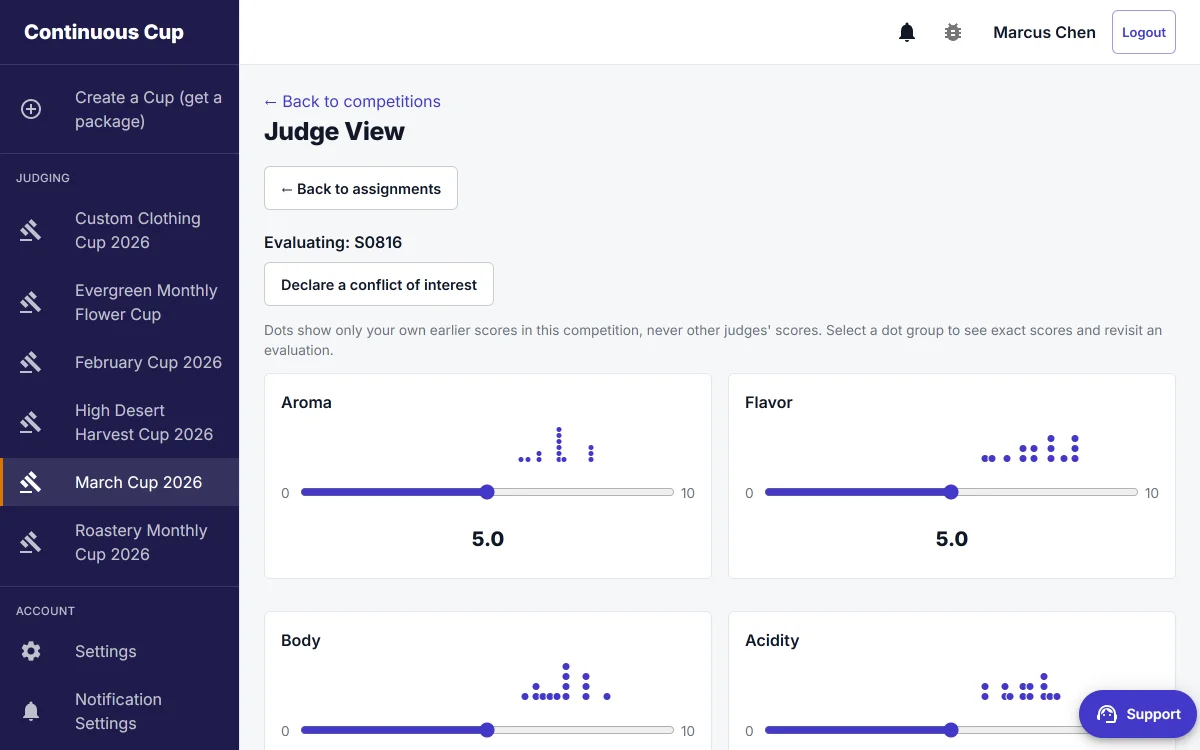
- Role-scoped views. A judge's screen is built to show only what a judge needs: the code and the entry. It does not include an entrant name field that someone forgot to hide, because that field is not part of the view at all.
- No master key circulating by email. The code-to-entrant mapping lives in the system, accessible only to the roles that need it for logistics, not as a spreadsheet attachment that grows more copies every time someone forwards it.
This is the difference between a platform built as competition judging software and a general spreadsheet or form tool pressed into service for judging: anonymization is a property of how the system is built, not a process everyone has to follow correctly every time.
How Continuous Cup anonymizes judging
Continuous Cup assigns every entry an anonymous code automatically as soon as it is submitted. Judges never see entrant names at any point in scoring, only the code and the entry in front of them. There is no shared codebook to protect, because the mapping is not a file that circulates, it is scoped to the roles that need it.
For categories where an entry has to be built for a specific judge, sizes, dietary needs, or similar preferences, Continuous Cup supports a fit-to-judge flow. Judges share what they need ahead of time, and entrants make their item to match. Neither side learns whose specs they got or whose entry they are judging, so even a built-to-order category stays anonymous. Once scores are in, an automatic bias check flags any judge whose scores drift from the rest of the panel, using statistics a single unusual score cannot throw off.
If you are still defining the criteria judges score against, how to create a judging rubric is the place to start before you worry about anonymity. For tasting formats specifically, tasting competition software covers keeping samples anonymous from drop-off to the judging table.
When not to anonymize judging, and what to do instead
Anonymization does not fit every judged format, and it is worth being honest about where it stops working. A live performance, a cooking demonstration judged in the moment, a race, or an interview round cannot be anonymized in any meaningful way, because the judge is watching the entrant do the thing in real time. Trying to force anonymity onto a format built around live observation just adds friction without removing the bias it is meant to address.
For those formats, the safeguards are different. Use a structured rubric so every judge scores the same criteria in the same order, rather than forming a general impression first and justifying it after. Calibrate judges against each other before the event, so you catch a harsh or generous scorer early. Run a bias check after scoring closes, comparing each judge against the panel, so a pattern shows up even without anonymity. How to score a competition fairly covers these practices in more depth, including how to combine scores once they are in.
Frequently asked questions
What is blind judging?
Anonymized judging, often called blind judging, means a judge scores an entry without knowing who submitted it. Instead of a name, the judge sees an anonymous code, so the score reflects what is in front of them, not who made it or whether they recognize the name. This is standard practice in most judged food, drink, and maker competitions because it keeps reputation and personal relationships out of the score.
What is the difference between blind and double-blind judging?
In judge-anonymized judging, what most people mean by blind judging, judges do not know who submitted an entry, but organizers still do, since someone has to award prizes and issue certificates. Double-anonymized judging adds another layer where entrants also do not know who judged them, and it matters most when the judge pool and entrant pool overlap, for example judges who also compete. Most cup-style competitions only need judge-anonymized. Double-anonymized is worth adding when judges enter as well.
Can judges also enter the competition they judge?
It happens often in hobbyist and trade competitions, and anonymized judging is what makes it workable. As long as an entry is anonymous when it is scored, a judge cannot tell that an entry belongs to a colleague, or in many formats, even to themselves. Organizers should still set a clear policy, recusal, separate categories, or a cap on how many judges also compete, rather than leaving it to chance.
How does Continuous Cup keep entrant identities away from judges?
Every entry gets an anonymous code automatically when it is submitted, and judges only ever see that code and the entry itself, never a name. Judge accounts are role-scoped, so a judge screen simply does not include an entrant identity field, the same way an entrant screen does not show other entrants scores. There is no shared spreadsheet or codebook that circulates by email and could leak the mapping.
What is the fit-to-judge flow?
Some categories need an entry built for a specific judge, for example a size or a dietary need, rather than judged after the fact. In the fit-to-judge flow, judges share sizes or dietary needs ahead of time, and entrants make their item to match. Neither side learns whose specs they got or whose entry they are judging, so the matching itself never breaks anonymity.
When should a competition not be judged blind?
Live performance events, a cooking demonstration, a race, or an interview round cannot really be anonymized, since the judge is watching the entrant in real time. For those formats, use a structured rubric so every judge scores the same criteria the same way, and run a bias check afterward to catch a judge whose scores drift from the panel.