Tasting competition software for coffee, homebrew, BBQ, and food contests
Tasting competition software is a platform that runs the physical and scoring side of a judged food or drink contest: logging entries as they arrive, keeping them anonymous once judges start tasting, building flights, capturing scores from judges at the table, and publishing results the room can trust. Coffee cuppings, homebrew and cider competitions, BBQ and chili cook-offs, baking contests, chocolate and hot sauce judgings, they all share the same hard parts, and a spreadsheet was never built to handle any of them.
Continuous Cup is built for that exact shape of event. It handles entry collection, optional anonymized judging, live scoring, and published results, so a coffee cupping, a homebrew competition, or a BBQ contest all run on the same platform without you gluing together intake forms, a scoring sheet, and a separate results page.
Continuous Cup is competition-management software for organizers who need to collect entries, coordinate judging, calculate scores, and publish trustworthy results from one platform. It is built for the parts that make tastings hard: flights and rounds, judges scoring from a phone at the table, and optional anonymized sample intake. See pricing or start free.
Sample intake and labeling is where most tasting events fall apart
A tasting competition has a physical bottleneck that a race or a bracket does not: someone has to receive a jar, bottle, plate, or bag from every entrant, attach an identity to it, and get it to the judging table without anyone downstream seeing whose name is on it. Continuous Cup gives every entrant a public competition page to register on, with a shareable link and whatever custom entry fields you need (category, division, ingredients, whatever your contest requires). At drop-off, you generate a QR code for each entry so intake staff can check samples in by scanning rather than typing names by hand.
If you run entry fees, Continuous Cup takes card payments at registration, so intake staff are checking a paid, registered entry against a code, not chasing a payment on the day.
Anonymity has to survive the trip from packaging to the judging table
The moment a sample leaves its original packaging, whatever kept it anonymous goes with it, unless you built anonymity into the process from the start. When judging is anonymized, every entry gets an anonymous code as soon as it is logged in Continuous Cup, and judges only ever see that code. You re-cup, re-plate, or re-bag under the code at staging, so the only thing in front of a judge is a number, never a name or a brewery logo.
For contests with a fit-to-judge step, like a homebrew style where entrants make something to a judge's stated preferences, Continuous Cup supports a flow where judges share sizes or dietary needs and entrants build to match, without either side knowing whose specs or whose entry they got. For a deeper walkthrough of the anonymity model, see anonymized judging software.
Flights and rounds need to track which judge tasted which sample
Once samples are anonymous, you still have to decide who tastes what, and in what order, without a judge seeing the same entry twice or an entry going unjudged. Continuous Cup's automatic assignment distributes entries across your judging panel with configurable overlap, so you control how many judges score each entry and how flights are built. That assignment record is also your audit trail: if a result gets questioned later, you can show exactly which judge scored which sample and when.
For events with a preliminary round feeding a finals table, table rounds into finals, heats into a final flight, Continuous Cup supports multi-round competitions where a defined set of entries advances between rounds. Each round is scored and tracked separately, so a strong first-round score does not quietly carry over into the finals ranking.
Palate fatigue is a logistics problem, not just a judging problem
Judges tasting fifteen chilis or twenty high-roast coffees in a row will not score the fifteenth the way they scored the first, and no scoring formula fixes that after the fact. The fix is upstream: cap how many samples any one judge scores in a session, watch for order effects (the sample right after the strongest entry often scores worse by comparison), and build in palate cleansers, water, plain crackers, or a short break between flights, as standard practice for any tasting category. Continuous Cup's assignment settings let you cap the number of entries per judge directly, so the limit is enforced when flights are built, not left as a suggestion on a printed schedule.
Judges score at the table, on whatever device they have
A judge standing over a tray of samples is not going to walk back to a desk to enter a score. Continuous Cup's scoring works on any device with a browser, phone, tablet, or laptop, so judges score the sample in front of them and move to the next one. Scores come in against weighted criteria you define for your rubric, and you can choose how those scores get combined: straight averages, robust normalization that limits how much one outlier judge can swing a result, rank-based scoring, or Many-Facet Rasch Measurement for panels where judge severity varies. If you are still building your first rubric, how to create a judging rubric covers that step, and how to score a competition fairly covers the aggregation choice in more depth.
Same-day walk-up contests need registration and check-in on-site
County-fair style contests, chili cook-offs, salsa contests, local baking competitions, often do not have a registration period at all. Entrants show up, register, and check in the same day their entry is judged. Continuous Cup's walk-up mode is built for that: entrants register on-site, get checked in, and their entry moves straight into the anonymized judging flow, without you needing a separate pre-event sign-up system.
Coffee cupping
Cupping sessions run on tight timing and consistent cup labeling, since the same roast tasted five minutes later can score differently. Assign anonymous codes at the roasting or sample-prep stage, not at the table, and keep flight size small enough that a judge's palate is still fresh for the last cup. Continuous Cup lets you model your own scoring rubric on whatever cupping form your organization already uses, without claiming any formal certification or affiliation.
Homebrew and cider
Homebrew judging typically pairs two or three judges per flight and separates entries by style category, so a stout is never compared against a saison. Keep bottle or growler labeling anonymous through staging (a code sticker over the original label works), and if your contest uses a fit-to-judge format, use Continuous Cup's anonymous matching so entrants build to a judge's stated preferences without either side knowing the other's identity.
BBQ and cook-offs
BBQ contests usually run on a strict turn-in clock, with boxes anonymized the moment they cross the table, so build your intake and QR check-in process around that deadline pressure rather than around leisurely registration. Cap samples per judge aggressively here: brisket, ribs, and sauce-heavy entries fatigue a palate fast, so a shorter flight with a cleanser break beats a marathon session that flattens every score toward the middle.
Baking
Baking contests often score on multiple criteria (appearance, texture, flavor) that benefit from a weighted rubric rather than a single number, so define separate criteria weights before entries arrive. Anonymity is usually easier here since entries are already on plates or trays; the main risk is a judge recognizing a signature technique or plating style, so rotate table assignments if the same judges see the same baker's work across categories in one event.
Results your entrants will actually trust
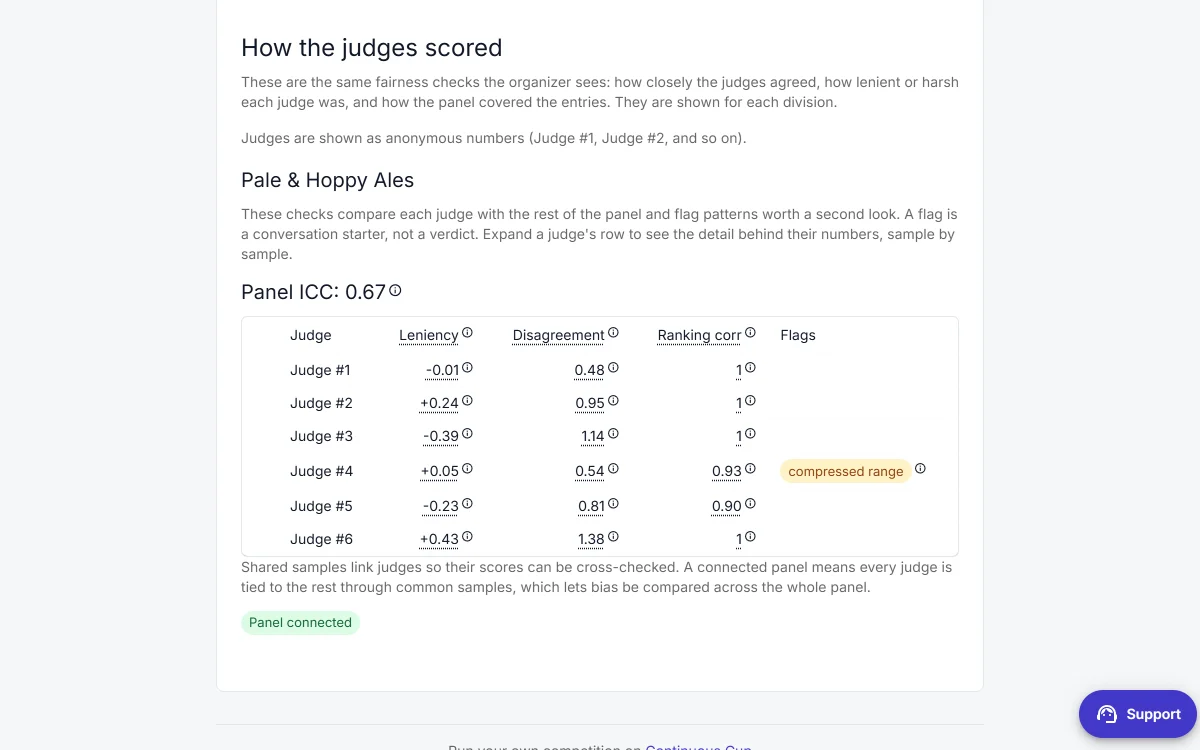
Tasting competitions attract disputes because taste is subjective and entrants know it. Continuous Cup's defensibility report shows, step by step, how each score was combined, with a public judging-transparency page for completed public walk-up events, and the automatic bias check flags any judge whose scores drift from the panel before you publish. A published results page, winner certificates, and verifiable credentials give entrants something concrete to point to. If you are moving off a spreadsheet entirely, this comparison walks through what changes, and how to run a judged competition covers the full event lifecycle from entries to results.
Frequently asked questions
How many samples can one judge score in a day?
That depends on the category and your judges, so set your own cap rather than borrowing a number from another organization. As a general rule, palates fatigue faster with strong or spicy samples (chili, hot sauce, high-roast coffee) than with mild ones, so build in breaks and palate cleansers between flights. Continuous Cup lets you control how many entries each judge is assigned, so you can set a limit that matches your category and stick to it.
How do entries stay anonymous once they leave their original packaging?
When judging is anonymized, Continuous Cup assigns every entry an anonymous code as soon as it is logged, and judges only ever see that code, never the entrant name. For physical samples, you print or generate a code at drop-off (a QR-code label works well) and re-cup or re-plate under that code so nothing in front of the judge points back to who made it.
Can entrants register and check in the same day, like at a county fair?
Yes. Continuous Cup has a walk-up mode built for exactly this: entrants register and check in on-site instead of applying ahead of time. You still get sample codes, anonymized judging if you enable it, and live scoring, just compressed into a single day.
Can judges score on their phones at the table?
Yes, judging works on any device with a browser, phone, tablet, or laptop. That matters for tastings because judges are usually standing at a table moving from sample to sample, not sitting at a desk.
How do we run multiple rounds, like table rounds into a finals table?
Continuous Cup supports multi-round competitions where a subset of entries advances from an earlier round into the next one. You set how many advance, judges score the finals round the same way, and the platform keeps each round separate in the results.
What if one judge scores everything much higher or lower than the rest of the panel?
Continuous Cup runs automatic bias checks that flag judges whose scores drift from the rest of the panel, using statistics that are not thrown off by a single unusual score. That flag shows up before you publish results, so you can look at it rather than finding out from an angry entrant.