Competition-day judging: run check-in, judging, and results on the day
Competition-day judging is running the whole competition in one day, in one place: entries arrive in the morning, get checked in and anonymized at the door, get judged by a panel in the room, and produce final results before everyone leaves. That is a different job from an online review window that runs for weeks, and it needs software built for the pace of a live event. Continuous Cup calls this competition-day mode, and it carries a single entry from the intake table to a published, defensible result without a spreadsheet in the middle.
Continuous Cup is competition-management software for organizers who need to collect entries, coordinate judging, calculate scores, and publish trustworthy results from one platform. Competition-day mode adds walk-up check-in, optional on-site anonymization, and a QR chain of custody for events decided in a room on a single day. See pricing or start free.
Why the day of the event is its own problem
An online competition has time on its side: entries come in over weeks, judges review at their own pace, and results can be tabulated after the fact. A same-day event has none of that slack. The field is not known until the doors open, entries arrive as physical items that have to be tracked without their owners names attached, judges score in real time under a clock, and results are expected before people go home. Run that on paper score sheets and a spreadsheet keyed in at midnight, and the day itself becomes the weak point: a sample handed to the wrong judge, a name overheard at the table, a tally added up under pressure. Competition-day mode exists to take those failure points off the table.
Walk-up check-in: register the field as it arrives
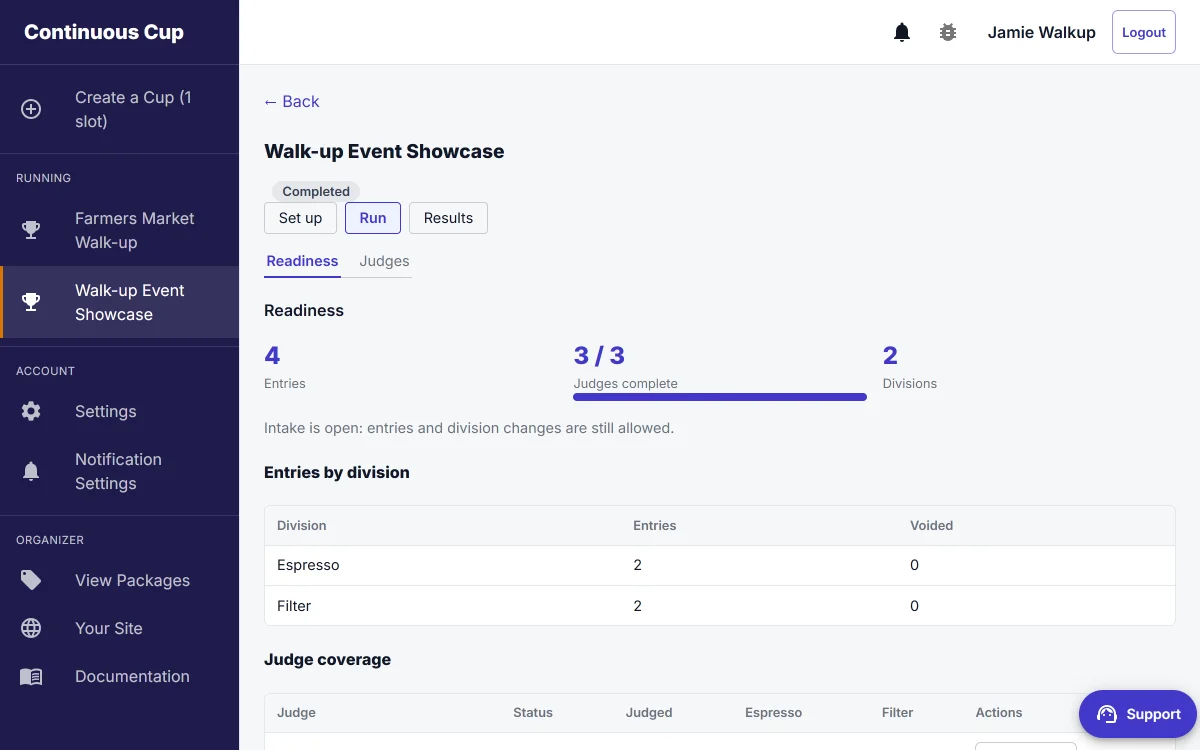
In competition-day mode, entries do not have to be registered weeks ahead. An organizer or volunteer at the intake table registers each entry as it walks up, assigns it to a division, and gives it an anonymous sample code on the spot. This suits cuppings, cook-offs, bake-offs, and craft contests where entrants show up the morning of the event with their entry in hand. You can still open entries online in advance and accept walk-ups on the day; the two mix in the same competition.
Anonymous sample codes assigned at the door
When judging is anonymized on a same-day event, anonymization has to start at intake, because the entry is a physical object that will pass through several hands. Continuous Cup assigns each entry an anonymous sample code the moment it is checked in, and from that point the entry is known by its code, not the entrant name. Judges score the code, never a name, the same way Continuous Cup enforces anonymization whenever judging is anonymized. See anonymized judging software for how that holds up under audit.
QR chain of custody from intake to the judging table
The risk on the day is not the scoring math, it is the handling: a sample that gets mixed up between intake and the table, or an entry whose identity leaks because someone wrote a name on it. Continuous Cup puts the sample code on a QR label, and staff move the entry through the event by scanning it: intake, staging, and the judging table each confirm the same code. The name-to-code mapping stays in the system, not on the table, so the physical entry travels by code and no one at the judging station can connect a sample back to a person. That is a chain of custody, the record of where each entry has been and who handled it, which is exactly what you want when a result is later questioned.
Live leaderboards spectators can follow
Because scores land in the system as judges submit them, a public competition can show a live leaderboard running during the event. Spectators and entrants can watch standings take shape instead of waiting for a final announcement, and organizers can see judging progress at a glance, which panels are done and which are still out. For the other scored formats that use the same live standings, such as heats, brackets, and leagues, see event scoring software.
Defensible final results before everyone leaves
When judging closes, results are already tabulated: Continuous Cup applies the weighted rubric and scoring method you chose, runs judge calibration and automatic bias and drift flags using robust statistics, and publishes a results page anyone can check. A defensibility report shows step by step how the final scores were combined, and completed public competitions get a transparency page with the same picture, so if an entrant asks how they placed, the answer is a page, not a promise. Winners can get certificates on the spot rather than in a follow-up email a week later.
How competition-day mode fits the rest of a competition
Competition-day mode is a workflow inside the same platform, not a separate product. Everything else about running a judged competition still applies: divisions and weighted rubrics, automatic overlapping judge assignment, optional multiple rounds, and Stripe entry fees if you charge to enter. For the full end-to-end walkthrough of planning, judging, and publishing a competition, see how to run a judged competition. To see how the whole platform fits together, see the judged competition platform overview.
Frequently asked questions
What is competition-day judging?
Competition-day judging is running a whole judged competition in a single day, on-site, rather than over an online review window that lasts weeks. Entries arrive the morning of the event, get checked in and anonymized on the spot, get judged by a panel in the room, and produce final results before everyone goes home. It needs software built for the pace of a live event, not for a slow review cycle.
How does walk-up check-in work?
In competition-day mode, an organizer or volunteer registers each entry as it arrives at the intake table, assigns it a division, and prints or attaches a sample code. The entrant does not need to have registered weeks ahead. This is the difference between a competition that opens entries online in advance and one where the field is not known until the doors open on the day.
How does the QR chain of custody keep judging anonymous?
When judging is anonymized, each entry gets an anonymous sample code at intake, carried on a QR label. From that point the physical entry travels by code, not by name: staff move it from intake to staging to the judging table by scanning the code, and judges score the code they are handed. Because the name-to-code mapping stays in the system rather than on the table, no one at the judging table can connect a sample back to an entrant.
Can spectators and entrants see results as judging happens?
For public competitions, yes: Continuous Cup keeps a live leaderboard that updates as scores come in, so spectators and entrants can follow standings during the event instead of waiting for an announcement. When judging closes, final results publish to a page anyone can check, backed by a defensibility report that shows how scores were combined.
Does the same competition still work for advance online entries?
Yes. Competition-day mode is an addition, not a replacement. You can open entries online ahead of time, accept walk-ups on the day, or do both in the same competition. The anonymization, assignment, scoring, and results all work the same way regardless of when an entry arrived.