Homebrew competition software: anonymized flights, fair scores, published results
Homebrew competition software is what turns a table of bottles, growlers, and jars into a judged competition with anonymous entries, a real judging panel, and results people trust. Beer, cider, and mead competitions share a specific set of hard parts: entries have to stay anonymous once they come out of their original packaging, judges need to be spread across the field evenly without seeing the same entry twice, and one strict or generous judge should not be able to quietly decide who wins. A spreadsheet and a stack of paper scoresheets do not solve any of that.
Continuous Cup is competition-management software for organizers who need to collect entries, coordinate judging, calculate scores, and publish trustworthy results from one platform. For homebrew, cider, and mead that means automatic judge assignment with built-in overlap, a choice of scoring methods to keep one outlier judge from swinging the standings, and optional anonymized judging with sample codes at intake. See pricing or start free.
See it running: the Harvest Moon Homebrew Championship
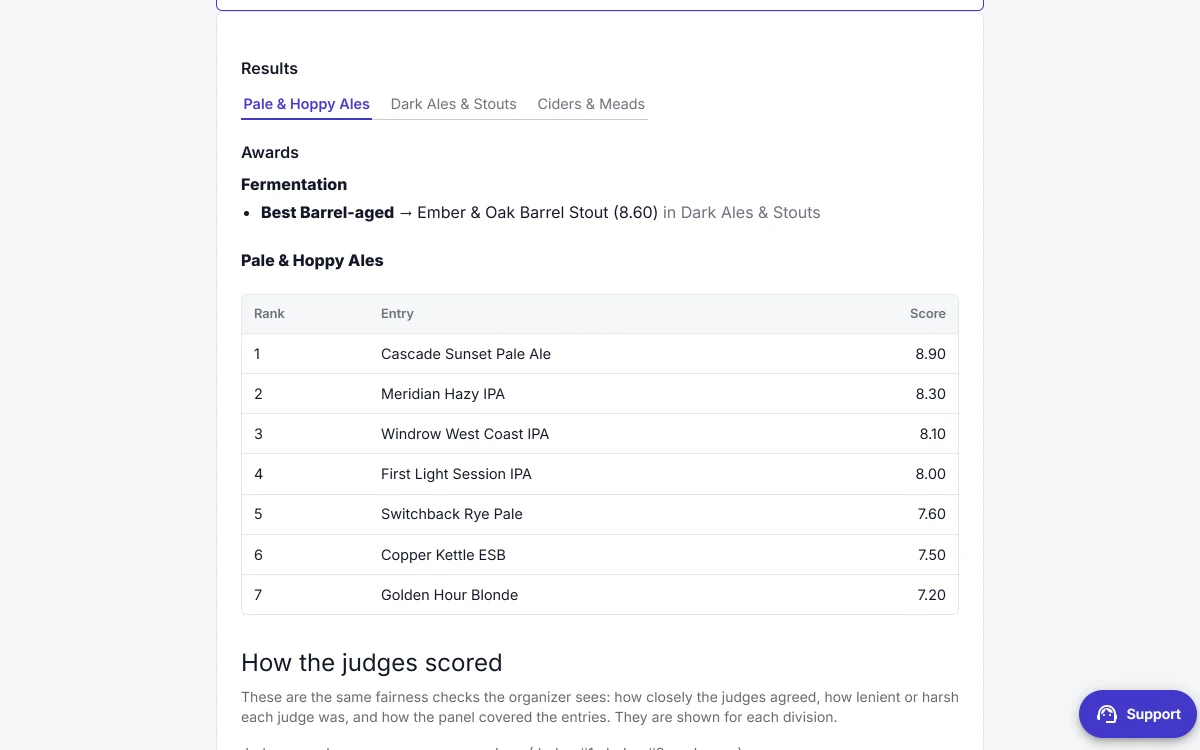
Rather than describe the workflow in the abstract, you can browse a real one. The Harvest Moon Homebrew Championship 2026 is a sample competition on Continuous Cup, a fictional event, not a real customer, but every part of it is the live platform, not a mockup. It carries 21 entries across three divisions, Pale & Hoppy Ales, Dark Ales & Stouts, and Ciders & Meads, scored by a six-judge panel judging anonymized entries. The results page publishes ranked standings inside each division plus a best-in-show award across styles, and the competition's public page includes a "How the judges scored" transparency section anyone can read. If you want to see a finished, defensible homebrew competition before building your own, that page is the fastest way in.
Build your own rubric, not someone else's certification
Continuous Cup does not ship a BJCP scoresheet, and using the platform does not imply BJCP affiliation, certification, or endorsement of any kind. Instead you build your own: turn your styles or categories into divisions (how Harvest Moon separates Pale & Hoppy Ales from Dark Ales & Stouts from Ciders & Meads), add custom fields for whatever you track alongside an entry (original gravity, ABV, the style guideline a brewer is judged against), and define the scoring criteria yourself. Whether your club already has a scoresheet or is writing one from scratch, it becomes your rubric, and how to create a judging rubric walks through that setup.
Anonymity has to survive the trip from bottle to judging table
A bottle or growler is not anonymous by default, it usually has a label or a distinctive cap. When judging is anonymized, every entry gets an anonymous code the moment it is logged in, and judges only ever see that code. At staging you re-bottle, re-pour, or cover the original label under the code, so the object in front of a judge carries no information about who made it. For on-site check-in, that code rides a QR label, and staff move the entry from intake to staging to the judging table by scanning it rather than reading a name, the same chain of custody Continuous Cup uses for competition-day judging. See anonymized judging software for the full anonymity model, and competition-day judging for how QR custody works when entries are checked in the day they are scored.
Judges assigned automatically, not by hand
No judge should see the same entry twice, and no single palate should carry a result on its own. Continuous Cup's assignment engine distributes entries across your panel automatically, spreading the load evenly and building in overlap between judges so results rest on more than one opinion. Assignment belongs to the competition as a whole rather than to a division, so if one division truly needs its own dedicated panel, say cider specialists who never taste a stout, run it as its own competition. The assignment record doubles as your audit trail: if a brewer questions a result, you can show exactly which judges scored their entry and when, the same way Harvest Moon's six-judge panel is recorded against its 21 entries.
Scoring on a weighted rubric, at the table
Homebrew judging typically scores an entry on more than one axis, aroma, appearance, flavor, and body and finish are the criteria the Harvest Moon evaluation form uses, and a single overall number rarely captures what separates a strong entry from a merely good one. Continuous Cup's evaluation form takes a weighted score on each criterion you define, and it works on any device with a browser, so a judge tasting at a table scores on a phone or tablet instead of a paper sheet someone re-types later. A QR scan can route a judge straight to the right evaluation for the entry in front of them.
Once scores are in, you choose how they combine: raw averages, a robust normalization method built to limit how much one unusually strict or generous judge can swing a division's standings, rank-based scoring, or Many-Facet Rasch Measurement for panels where judge severity varies. Robust normalization targets the problem homebrew panels run into most: a judge who scores everything a point low across a division should not cost every brewer in it. How to score a competition fairly covers those tradeoffs in more depth.
Same-day club competitions and larger scheduled events, one workflow
Not every homebrew competition has a multi-week entry window. A club meeting, a one-day festival pour-off, or a county fair-style contest often needs entrants to register and check in a bottle the same day it gets judged. Continuous Cup's walk-up mode handles that: an entry registered midmorning can be anonymized, assigned to a judge, and scored by early afternoon, without a separate advance sign-up system. You can also run a scheduled competition with weeks of advance entries, or mix both in the same event, since anonymization, assignment, and scoring work the same either way.
Results brewers will actually trust
Homebrew competitions draw the same kind of dispute any subjective judging does: a brewer wants to know why their entry placed where it did, not just that it did. Continuous Cup publishes results grouped by division, the way Harvest Moon separates its Pale & Hoppy Ales standings from its Dark Ales & Stouts standings, with a best-in-show award layered on top for the strongest entry across styles. Behind that published page sits a defensibility report, and for completed public walk-up events a "How the judges scored" transparency section, the same section Harvest Moon's public page carries, showing step by step how scores were combined and flagging any judge whose scoring drifted from the panel before results go out. See the real thing in the sample defensibility report, built from the same pipeline that runs on every live competition.
Where this fits if you run more than one kind of tasting
Beer, cider, and mead are one slice of a broader category. If you also run coffee cuppings, BBQ, or food contests alongside homebrew, tasting competition software covers the shared ground, sample intake, palate fatigue, and flight design, while this page stays focused on what is specific to homebrew: style divisions, bottle anonymity, and BJCP-independent rubrics. For the full lifecycle from planning entries through publishing results, how to run a judged competition is the end-to-end walkthrough, and if you are moving off scoresheets and a spreadsheet entirely, this comparison covers what changes.
Frequently asked questions
Does Continuous Cup use BJCP scoresheets, or require BJCP certification for judges?
No. Continuous Cup is not affiliated with or endorsed by BJCP, and it does not ship a BJCP scoresheet. Instead, you build your own rubric: turn your styles or categories into divisions, add whatever custom fields you track (original gravity, ABV, the style guideline you judge to), and score against criteria you define. That can be a scoresheet your club already uses or one you write from scratch, it is your rubric either way.
How does anonymized judging work once a bottle or growler is out of its original packaging?
When judging is anonymized, every entry gets an anonymous code as soon as it is logged in, and judges only ever see that code, never a brewer name or label. You re-bottle, re-pour, or cover the label under the code at staging, and a QR label carries that code through intake, staging, and the judging table, so the entry travels by code and nothing at the table points back to who made it.
How are judges assigned across style divisions, like pale ales versus stouts versus ciders?
Continuous Cup assigns entries to your judging panel automatically, distributing the load evenly and building in overlap between judges so the panel stays statistically connected. You are not manually deciding who tastes what; the system spreads entries across the panel and keeps a record of exactly which judge scored which entry. Assignment belongs to the competition, not to a division, so if a division needs its own dedicated panel, run it as a separate competition.
What happens if one judge scores a division much stricter or more generous than the rest of the panel?
Continuous Cup can normalize scores with a robust statistical method built to limit how much a single unusually strict or generous judge can swing the standings, rather than taking every raw score at face value. That calibration runs before results publish, so a lenient or harsh judge in one division does not quietly decide the outcome.
Can a homebrew club run a same-day walk-up competition instead of a mail-in or scheduled drop-off event?
Yes. Walk-up mode lets entrants register and check in a bottle the same day it gets judged, so a club meeting or a one-day festival can run entries straight through intake, anonymous coding, judging, and results without a separate advance registration period.
Is there a real homebrew competition I can look at before setting one up?
Yes. The Harvest Moon Homebrew Championship 2026 is a sample competition running on Continuous Cup that you can browse in full, entries, divisions, judges, and published results, at demo.continuouscup.com/c/BREW26. It is a fictional sample built to show the workflow, not a real customer, but every feature it shows is the real platform.